






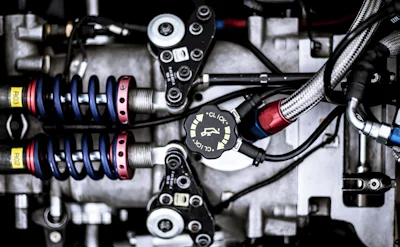


Internal Combustion Engine:-
The internal combustion engine is employed in automobiles. In order to run these engines, the air-fuel mixture burns in the engine cylinder to develop power. The following are the two types of I.C. engine which are commonly used in automobiles.
- Petrol engines (Spark ignition engines):- In petrol engines, the air and fuel mixture is drawn during the suction stroke. The mixture is compressed to approximately 20 to 30 bar ( compression ratio 6 to 10 ) in the compression stroke, thus raising the temperature in the range of 400 to 500°C. The temperature reached after compression is below the auto-ignition threshold of the air-fuel mixture, and it is ignited with the help of a spark plug before the piston reaches the top dead centre.
The petrol engine works on the Otto cycle ( also known as the constant volume cycle ). In Otto's cycle, combustion takes place at constant volume, as the whole of the fuel is burned instantaneously as an explosion.
- Diesel engines ( compression ignition engines ):- In diesel engines, the air is drawn during the suction stroke, which is compressed to approximately 30 to 45 bar ( compression ratio, 14 to 25 ), thus raising the air temperature in the range of 700 to 900°C. Into this glowing hot air, the fuel is injected through a nozzle and finely dispersed. It evaluates, mixes with air and ignites spontaneously. During combustion, the pressure increases in the range of 55 to 75 bar. The burned gases, under full load, are at a temperature of about 600°C, but in the case of petrol engines, it is 900°C. Thus, it may be noted that a diesel engine utilises the heat of the fuel to a better degree, and for this reason,n its fuel consumption is lower.
The diesel engine works on the diesel cycle (also known as the constant pressure cycle). In the diesel cycle, the combustion takes place at constant pressure because burning takes place gradually, without an explosion as the fuel enters.
Parts of an I.C. Engine:-
There are several parts of the I.C. engine:-
- Cylinder head:- The cylinder head forms a part of the combustion chamber and is subjected to high temperature and pressure. It requires good heat conduction and can be readily cooled. These are generally made up of aluminium alloy, but there are also some cast-iron cylinder heads. Aluminium alloy cylinder heads use seat rings in the valve seats, and for the exhaust valves, these are often made with better heat resistance than those for the inlet valves.
- Cylinder head gasket:- The cylinder head gasket is designed to prevent the combustion gases from leaking from the joint between the cylinder block and cylinder head. It should be resistant to pressure and heat, and should be compressible by an appropriate amount. The main types of cylinder gaskets are metal, made from a single soft steel plate. The most commonly used compound cylinder head gaskets are metal asbestos gaskets, wire woven gaskets and metal graphite gaskets.
- Cylinder and cylinder block:- The cylinder and cylinder block are normally cast as a single unit, but sometimes cylinder liners are inserted into the cylinder block, which can be replaced when worn out. The inside of each cylinder liner is given a fine crosshatch pattern through a machining process known as honing. In order to reduce friction and wear on the cylinder from the sliding movement of the piston, the piston is ground to a very fine finish. The material used for the cylinder block is grey cast iron or aluminium alloy. It may be noted that the cylinder block is the foundation of the engine. The other engine parts are attached or assembled into the cylinder block.
The internal diameter of a cylinder is referred to as either cylinder bore or simply bore. The engine's displacement is determined by the bore, the piston stroke (i.e. the distance that the piston travels between TDC and BDC), and the number of cylinders employed. In a multi-cylinder engine, the distance between the centres of adjacent bores is known as the bore pitch. The distance from the cylinder top surface to the crankshaft's centreline is called the block height. ( This is the same in the case of a V-type engine also) .
- Piston:- The main function of a piston is to transmit the force exerted by the burning of the charge to the connecting rod. Since the pistons move backwards under high temperatures and pressure, they should have very good heat conduction and wear resistance, and should be lightweight. The material used for pistons is aluminium alloys made from aluminium with copper, silicon, nicke , etc.
- Piston rings:- The piston rings are housed in circumferential grooves provided on the outer surface of the piston. The piston rings must be resistant to wear, tough, resistant to heat, and be able to hold oil. Generally, there are two sets of rings: compression rings and oil control rings. The compression rings are made from a special cast iron or carbon steel. The primary function of the compression ring is to form a gas-tight seal between the piston and inner wall of the cylinder, while at the same time transmitting the heat to the cylinder that the piston receives during combustion. The oil control rings are made from carbon steel, and their function is to provide an effective seal to prevent leakage of the oil into the engine cylinder.
- Connecting rod:- It is a link between the piston and crankshaft. The main function of the connecting rod is to transmit force from the piston to the crankshaft. Moreover, it converts the reciprocating motion of the piston into the circular motion of the crankshaft, in the working stroke. Since the piston moves vertically while the crankshaft rotates, the connecting rod is subjected to a combination of axial and bending stresses. Consequently, the connecting rod must be as light and rigid as possible.
The upper (i.e. smaller) end of the connecting rod is fitted to the piston by the piston pin, and the lower (i.e. bigger) end to the journal of the crankshaft. The connecting rods are die-forged from special steels, such as I-shaped cross-section, to make the connecting rod itself light.
- Crankshaft:- The function of a crankshaft is to convert the reciprocating motion of the piston (due to the combustion of the air-fuel mixture) into the rotary motion with the help of a connecting rod. It consists of crank pins, webs (crank arms or cheeks), balancing weights and main journals. The crankshaft is supported by the main bearings on the main journals. The balancing weights are provided on the opposite side of the crank arms for balancing. Since the crankshaft rotates at high speeds under heavy loads, it must have good strength and wear resistance. It must have both static and dynamic balance, and must be able to rotate smoothly.
The number of main bearings depends upon the design of the engine and the number of cylinders. It may be noted that the more the number of main bearings, the less the possibility of vibration and distortion of the crankshaft of a given size. In order to reduce vibration in the engine, the crankshaft and flywheel are balanced separately. Balancing is necessary to prevent severe damage to the engine, especially to the bearings. The crankshaft is generally made from carbon steel, special steel, or special cast iron.
The crankshaft may be forged or cast, but the former method is more common. After die forging, the shaft is machined mechanically, and to improve wear resistance, the surface of journals and crankpins is generally hardened by carburising and then ground.- Valve mechanism:- Since the valves are subjected to high working temperatures, they must have good heat conduction, heat resistance, corrosion resistance, wear resistance and shock resistance.
The material for inlet valves is usually a special carbon steel including silicon and chrome. This are particular good corrosion resistance, and also has good heat conduction and a low coefficient of expansion.
The exhaust valves are subjected to high temperatures, so the material used for exhaust valves is a special steel made by including chrome and nickel in carbon steel. This alloy has particularly good heat resistance and corrosion resistance.- Crankshaft:- The camshaft is usually forged from special steel, including nickel, chrome and molybdenum or cast from special cast iron. The cams and journals are normally carburised or given some other surface hardening treatment to improve wear resistance.
- Valve springs:- The valve spring needs to provide a spring force that rapidly and precisely closes the valves in accordance with the cam movement. Since they are repeatedly compressed and relaxed together with the engine speed, they should be resistant to fatigue and very tough. The material is usually heat-resistant spring steel, chrome vanadium steel or silicon chrome steel.
- Diesel engines ( compression ignition engines ):- In diesel engines, the air is drawn during the suction stroke, which is compressed to approximately 30 to 45 bar ( compression ratio, 14 to 25 ), thus raising the air temperature in the range of 700 to 900°C. Into this glowing hot air, the fuel is injected through a nozzle and finely dispersed. It evaluates, mixes with air and ignites spontaneously. During combustion, the pressure increases in the range of 55 to 75 bar. The burned gases, under full load, are at a temperature of about 600°C, but in the case of petrol engines, it is 900°C. Thus, it may be noted that a diesel engine utilises the heat of the fuel to a better degree, and for this reason,n its fuel consumption is lower.
The diesel engine works on the diesel cycle (also known as the constant pressure cycle). In the diesel cycle, the combustion takes place at constant pressure because burning takes place gradually, without an explosion as the fuel enters.
Parts of an I.C. Engine:-
There are several parts of the I.C. engine:-


No comments:
Post a Comment
Please do not enter any spam link in the comment box